

Issues regarding the free movement of goods between borders, cooperation in the areas of logistics and rail freight were discussed with the Minister of Transport of the Czech Republic
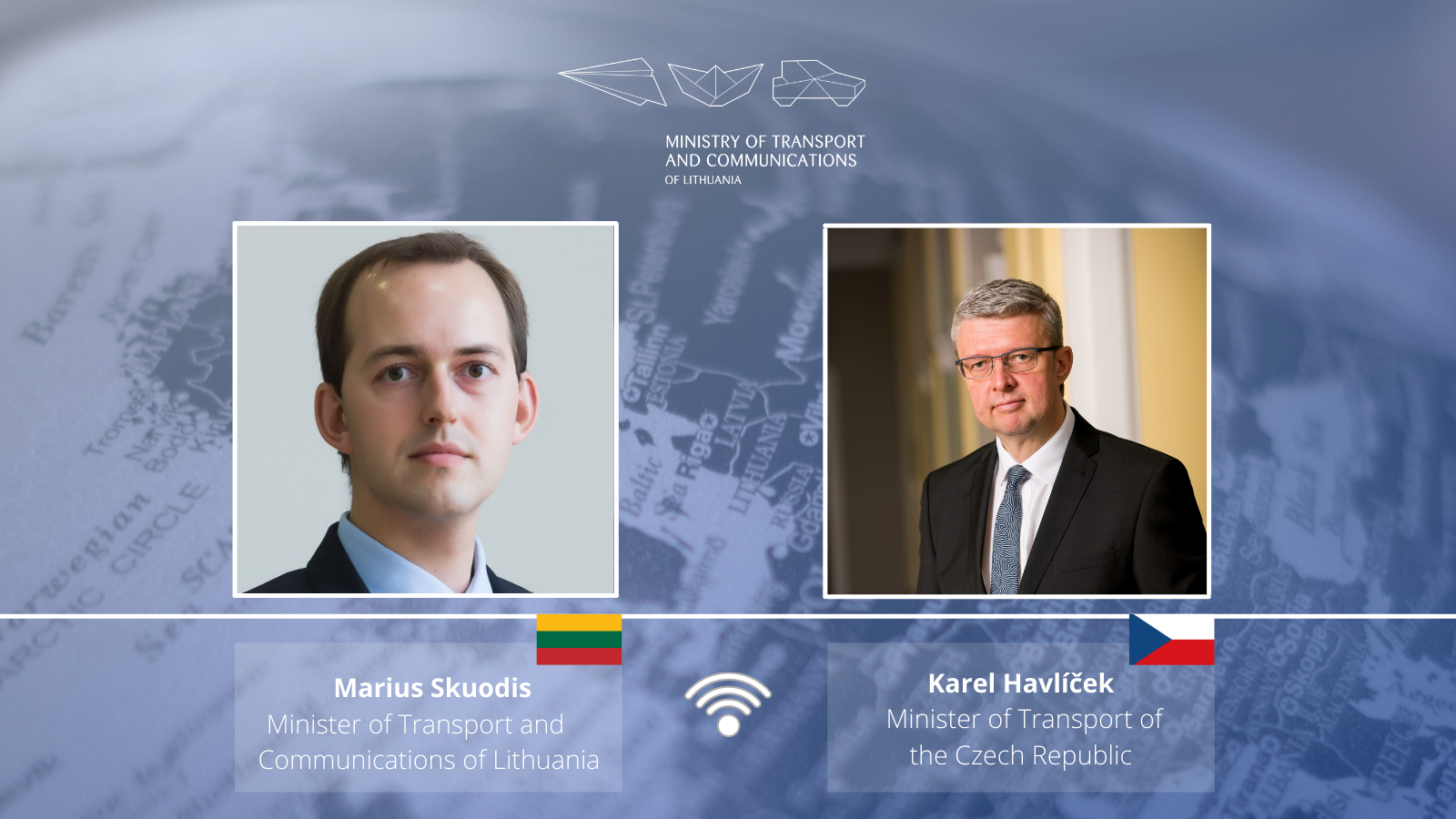
Minister of Transport and Communications Marius Skuodis met remotely with Minister of Transport of the Czech Republic Karel Havlíček on Thursday and discussed the free freight transport via green lanes in Europe. During the meeting, attention was brought to the difficult situation at the borders of Germany, Austria and the Czech Republic, where recent additional safety measures have been introduced to limit the spread of the COVID–19 virus and its mutations, and traffic congestion has been building up.
"Unfortunately, this situation is yet another recurring challenge for all EU countries to ensure compliance with fundamental principles and values of the Community in the context of a complex epidemiological situation. It is clear that an urgent coordinated response is needed at present, both at the EU and regional levels, and that there is a need for more active coordination of the movement of persons and goods across borders, as the increasing congestion creates only more problems," said Minister of Transport and Communications Skuodis.
According to Czech Minister of Transport Havlíček, the Czech Republic is taking all possible measures to prevent the spread of the coronavirus and its strains, and the country has tightened control at land borders. He says that the main thing is the negative test required by carriers both when arriving in the Czech Republic and when going to Germany, Slovakia, Austria, as well as on the opposite side.
The ministers also discussed cooperation in the area of rail transport. For over 10 years, Lithuanian Railways has been using electric trains manufactured by Škoda Vagonka, which run on electrified sections Vilnius–Kaunas, Vilnius–Trakai and Vilnius–Minsk. Economic cooperation between the regions of the Baltic, Black and Adriatic seas should be accelerated by the development of high-speed rail lines linking Poland, the Czech Republic, Slovakia and Hungary. The project is scheduled to start in 2025.
According to Skuodis, the Rail Baltica project, which is planned to be completed by 2026, will ensure even better connection between the Baltic and Central European countries, as well as the possibility to conveniently travel and transport cargoes, so the works should not be delayed. It is expected that the agreement reached at last year's European Council on the funding of the Rail Baltica project will be maintained and it will be possible to pursue the "ambitious agenda".
The ministers expressed hope that the railway transport sectors of both countries will find opportunities for cooperation in the future. Skuodis noted that Lithuania intends to actively participate in energy, transport infrastructure and digitalisation development projects implemented under the Three Seas Initiative.