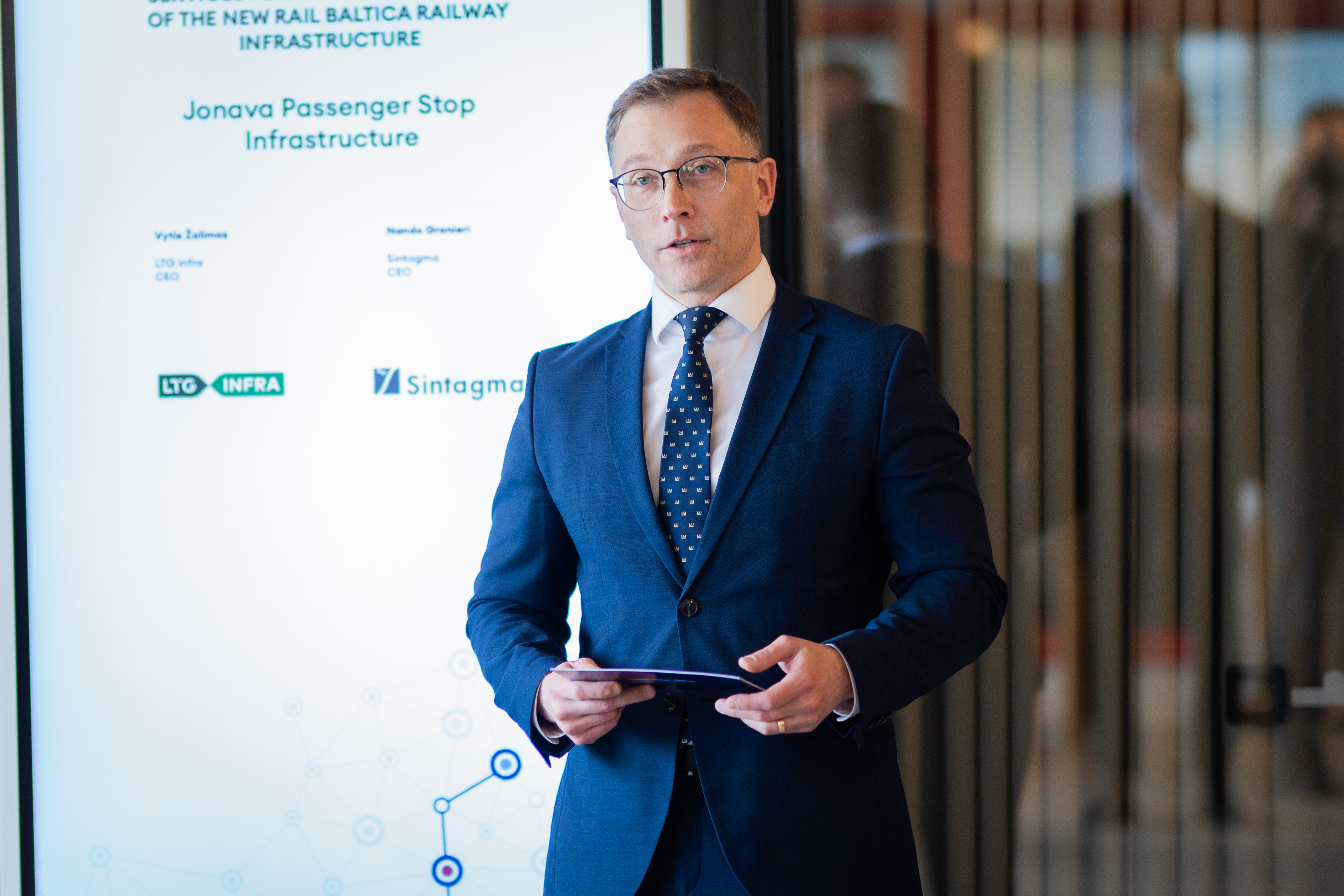
Italian Engineering Firm Sintagma to Design Rail Baltica Regional Station Infrastructure in Lithuania

LTG Infra, the infrastructure company of the LTG Group implementing the Rail Baltica project in Lithuania, has signed two new contracts for the design and construction supervision of regional passenger station infrastructure. Both tenders were awarded to the Italian company Sintagma.
The value of the infrastructure design and construction supervision works at the Jonava passenger stop amounts to EUR 2.18 million (incl. VAT). The works for the larger Panevėžys (Gustonys) passenger station are valued at EUR 7.02 million (incl. VAT).
Juras Taminskas, Minister of Transport and Communications of Lithuania, has consistently emphasized the steady progress of the Rail Baltica project in the country. With embankment construction and track laying underway, the project is now advancing to the design of infrastructure for regional stations, such as platforms, viaducts, and access roads.
“The new European-gauge railway will enable faster and more convenient connections between Kaunas, Jonava, and Panevėžys. Each kilometre of Rail Baltica and every new station in development also marks an investment in our national security, resilience and regional growth,” says Roderikas Žiobakas, Deputy Minister of Transport and Communications of Lithuania.
According to Vytis Žalimas, CEO of LTG Infra, the Rail Baltica project continues to attract partners from across Europe.
“Regional infrastructure encompasses not only the railway itself, but also connections, passenger stations and stops integrating rail with other modes of transport. The more convenient and accessible the infrastructure, the better the connectivity of regions. Rail Baltica infrastructure is designed and implemented in line with the highest standards of sustainable and efficient mobility,” says Žalimas.
Stations Designed for Modern and Convenient Mobility
Sintagma is an Italian engineering company specializing in large-scale infrastructure projects, primarily in the design of railways, roads and bridges.
“The Panevėžys passenger station and the Jonava stop infrastructure represent two strategic milestones for Sintagma. These projects mark our first presence in Lithuania and reinforce our long-term commitment to the Rail Baltica program, contributing to the development of high-quality infrastructure for future generations.
Sintagma has been actively involved in this visionary European initiative since 2018 and is now among the most active Italian engineering companies with the most extensive portfolio of contracts within Rail Baltica. With extensive successful experience gained in Latvia, we are confident that this expertise will also bring tangible benefits to local communities in Lithuania,” says Sintagma CEO Nando Granieri.
Sintagma will design the infrastructure of the Panevėžys (Gustonys) passenger station and the Jonava passenger stop infrastructure, including engineering networks, railway and access roads, viaducts and platforms. Four platforms are planned in the Panevėžys district and two in Jonava.
The contracts stipulate that the infrastructure must meet modern functional requirements, including convenient and safe access, clear wayfinding and passenger information systems.
Design services are planned to be delivered within 24 months. Upon completion of the design phase, construction contracts will be concluded, during which Sintagma will provide construction supervision services.
The company is responsible for the design of railway station infrastructure. Station buildings will be designed under separate projects, with tenders for these contracts expected to be launched in the near future.
Rail Baltica is a strategic project for both the LTG Group and the European Union and is the largest railway infrastructure project in the history of the Baltic States. Once completed, it will deliver an electrified European standard gauge railway line connecting Lithuania, Latvia, and Estonia with Central and Western Europe, strengthening regional integration, civil and military mobility, and the overall resilience of the transport system.