

Seaports of Klaipėda and South Korea to cooperate in the fields of digitisation, innovation and environmental protection
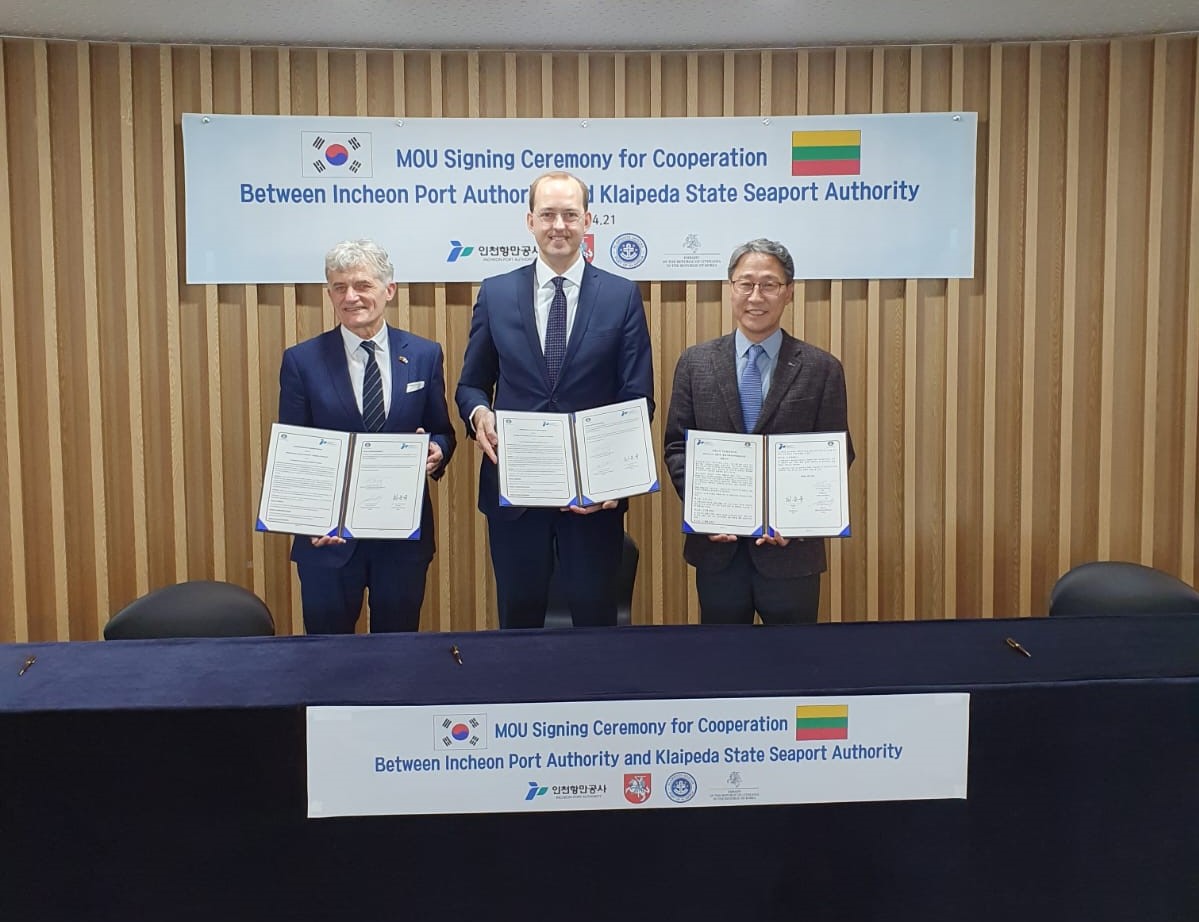
The seaports of Klaipėda and Incheon in South Korea have agreed to exchange knowledge and experience in developing sustainable and harmonious port development. This is provided for in the Memorandum of Understanding signed today by Port of Klaipėda Director General Algis Latakas, Incheon Port Authority President Choi Joon-Wook, and Lithuanian Minister of Transport and Communications Marius Skuodis.
It is expected that this document will also contribute to strengthening the Lithuanian maritime sector and developing competences in numerous key areas, such as environmental protection, innovation and digitisation.
“This is the first visit to South Korea of representatives of the Seaport Authority of this level with the aim of developing cooperation and establishing closer ties. The main objective of the visit is the search for common points of contact and sharing experiences on shipping, port development and sustainability. The signing of the cooperation agreement lays the foundation for closer ties, both today and in the future,” says Klaipėda State Seaport Authority Director General Algis Latakas.
In the cooperation agreement, the ports undertook to share statistics, organise joint meetings and seminars, and, if necessary, help each other initiate dialogue with terminal operators and shipping lines in order to increase the number of cargoes and passengers and diversify shipping routes. Both ports also plan to promote each other to shipping companies and exporters and develop close ties.
“We very much appreciate the increasing cooperation with South Korea in the field of maritime transport and hope to further strengthen and develop it. The memorandum signed today between the ports of Klaipėda and Incheon will allow both countries to share expert experience and good practices for the sustainable development of shipping and ports. The port’s ties with South Korea are extremely important in the formation of new global cargo transport routes,” says Minister of Transport and Communications Marius Skuodis.
The history of the Port of Incheon dates back to 1883. The port has a container terminal that can accommodate vessels with a capacity of 4,000 TEU; 43 ships can berth here at the same time. The containers mainly transport cars, grain and other goods. Sand and other cargoes are loaded in the southern part of the port, while industrial raw materials, wood, scrap metal and feed are loaded in the northern part.
The Port of Incheon has a passenger terminal that connects the port city to islands in the West Sea, an international passenger terminal that connects it to 10 major cities in North China, and a cruise ship terminal.
Located just over 40 kilometres from Seoul, the port aims to become the most modern logistics and maritime tourism hub in Northeast Asia in the coming years. The goal of this South Korean port is to be a safe and environmentally friendly port with a management system based on innovation and cooperation.
One of the most important development projects at the Port of Incheon is the expansion of the international passenger terminal, which is expected to combine both leisure and entertainment under one roof. The Port of Incheon has set itself a target of attracting 5 million maritime tourists by 2030.